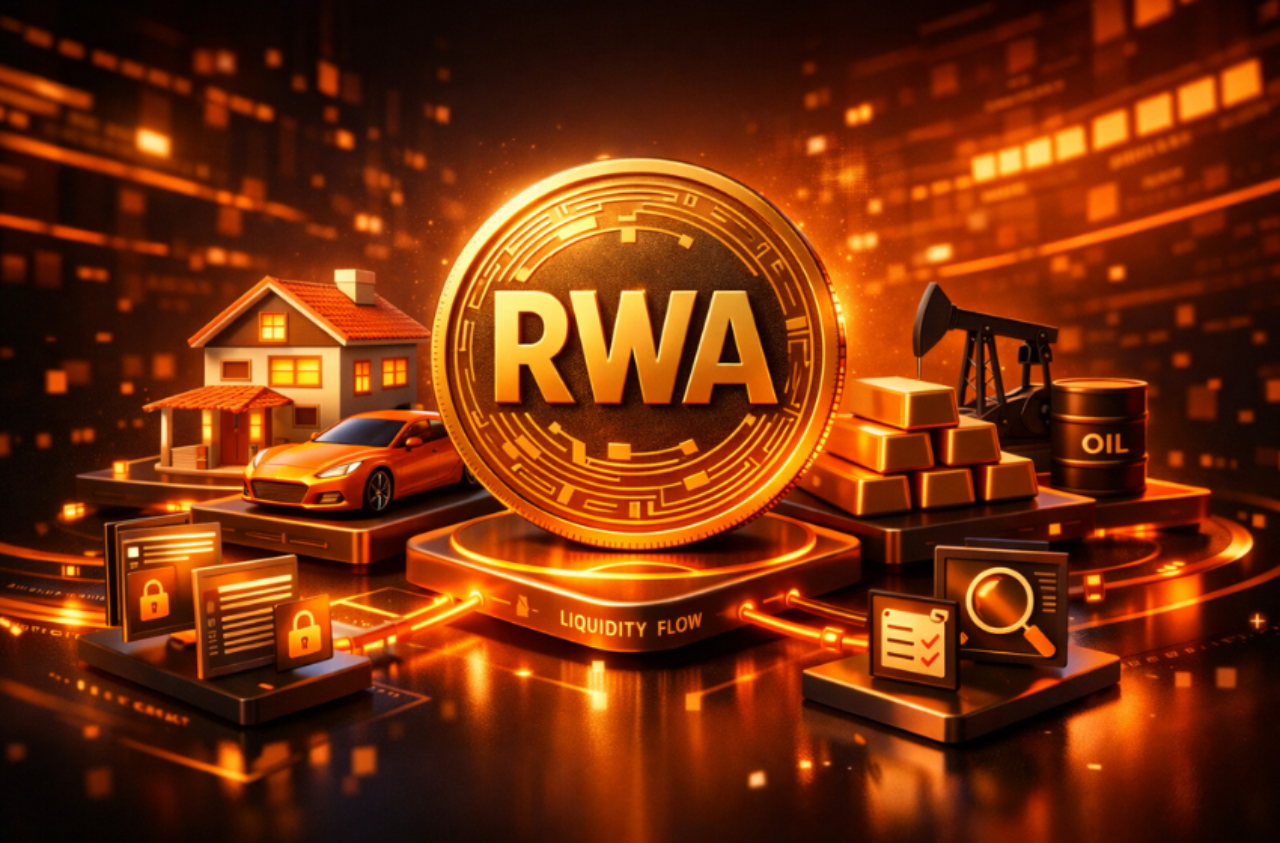

The crypto economy is evolving at a rapid pace and, as it moves forward, it is shifting away from purely speculative narratives toward models supported by verifiable data, transparent governance, and applications that connect with real-world economic fundamentals.
Within this movement, two technical pillars are gaining relevance: the tokenization of Real-World Assets (RWAs) and the growing demand for on-chain transparency as a structural element of trust.
These two fronts are not isolated concepts. On the contrary, they form an increasingly interdisciplinary field of study that involves network economics, incentive theory, computational security, and decentralized custody models. Together, they outline the next stage of crypto asset maturity.
Why Real-World Assets became a central development vector
The tokenization of real assets such as commodities, infrastructure, financial instruments, or traditional revenue streams represents both a technological advance and a convergence point between regulated markets and programmable finance.
From a technical perspective, RWAs function as digital representations of assets that have verifiable correspondence outside the blockchain. This expands the applicability of distributed systems by creating bridges between global liquidity, fragmented markets, and custody models that have historically relied on intermediaries.
Several academic studies and institutional reports indicate that RWAs reduce operational friction by introducing instant liquidity, standardized contracts, and permanent auditability.
They also enable more precise quantitative analysis, since every transaction leaves an immutable cryptographic trail, allowing for independent external audits and probabilistic verification models.
At the same time, RWAs raise classic challenges related to oracle theory and the reliability of external information. This pushes the sector to develop hybrid validation mechanisms that combine computational proofs, external audits, and legal custody structures.
The evolution of this ecosystem therefore depends on models capable of connecting regulated environments to distributed systems without compromising security or data verifiability.
On-chain transparency as a scientific foundation of trust
If tokenization brings the sector closer to real assets, on-chain transparency establishes itself as its essential technical counterpart. In distributed systems, trust is not built through statements from central entities, but through mathematically verifiable mechanisms.
The immutability of blockchain state, combined with public record structures, creates an environment where continuous audits become possible without the need for intermediaries.
In this context, transparency is a direct consequence of formal principles such as distributed consensus, Merkle Tree verifiability, and the deterministic properties of smart contracts. These elements reduce information asymmetry and allow any participant to locally reproduce the system state, independently validating balances, flows, and rules.
For this reason, projects that rely on reserves, collateral, guarantees, or deflationary models tend to benefit from fully auditable structures.
Public monitoring of contracts, wallets, and events facilitates independent analysis, hypothesis testing, and continuous risk monitoring, something rare in traditional markets where much of the information remains opaque or restricted to central institutions.

The convergence between RWAs and on-chain transparency
The integration of real-world asset tokenization and on-chain transparency marks a new theoretical and practical stage of the crypto economy.
This convergence creates environments where economic flows from the physical world are monitored through mathematically verifiable mechanisms, resulting in hybrid models with the potential for greater efficiency, traceability, and reduced reliance on intermediaries.
It also opens up a fertile research field: how to structure smart contracts that represent rights over physical assets, comply with local regulations, and still maintain security and operational autonomy? How can off-chain information be validated without introducing vulnerabilities?
These questions have driven studies on trust-minimized oracles, external consensus proofs, and algorithmic governance structures.
Projects that combine real backing, auditable reserves, and immutable operating rules become useful case studies to observe this transition. They allow for data-driven analysis of how hybrid structures respond to volatility, liquidity challenges, custody issues, and market pressure.
RWAs and transparency as pillars of the next phase
The crypto economy is moving toward a stage where models supported only by narrative tend to lose ground to solutions that demonstrate alignment with measurable fundamentals.
The combination of real-world assets and on-chain transparency mechanisms creates an environment where governance, auditing, security, and efficiency become both desirable and necessary.
It is worth emphasizing that this evolution does not eliminate technological, operational, or regulatory risks. However, it provides more mature tools to assess them and, above all, to build financial systems that operate in a verifiable, programmable way and remain connected to the global economy.
RWAs and on-chain transparency, therefore, stop being mere trends and begin to represent a new phase of scientific experimentation and infrastructure development in the crypto sector.
If you want to see more content like this about the EVA ecosystem and the crypto space as a whole, keep following our channels and check out our upcoming publications.